
Hello.
I am Yoon Somang, Representative Administrative Agent at Insight Administrative Agent Office.
“I changed to an English name when I got my U.S. citizenship, but I haven’t reported the loss of my Korean nationality yet."
"My Korean documents show my Korean name, but my citizenship certificate and passport show a different name, so I don’t know how to prepare for the F-4.”
In a situation like this, it can feel as if both the report of loss of nationality and your F-4 preparation are stuck at the same time.
Let me start with the conclusion.
If you acquired a foreign nationality voluntarily, you lost Korean nationality when you acquired the foreign nationality, not on the date you report it.
What you need to do now is have that fact reflected in Korean records, while linking your Korean name, your name at naturalization and your current passport name through official records.
This article focuses on cases where the name changed at naturalization and sets out what each document does and the order in which to prepare them.
The general case where the names in Korean records and foreign documents differ is explained in Same-person documents to prepare when your citizenship and Korean documents show different names.
If I haven’t reported it, do I still have Korean nationality?
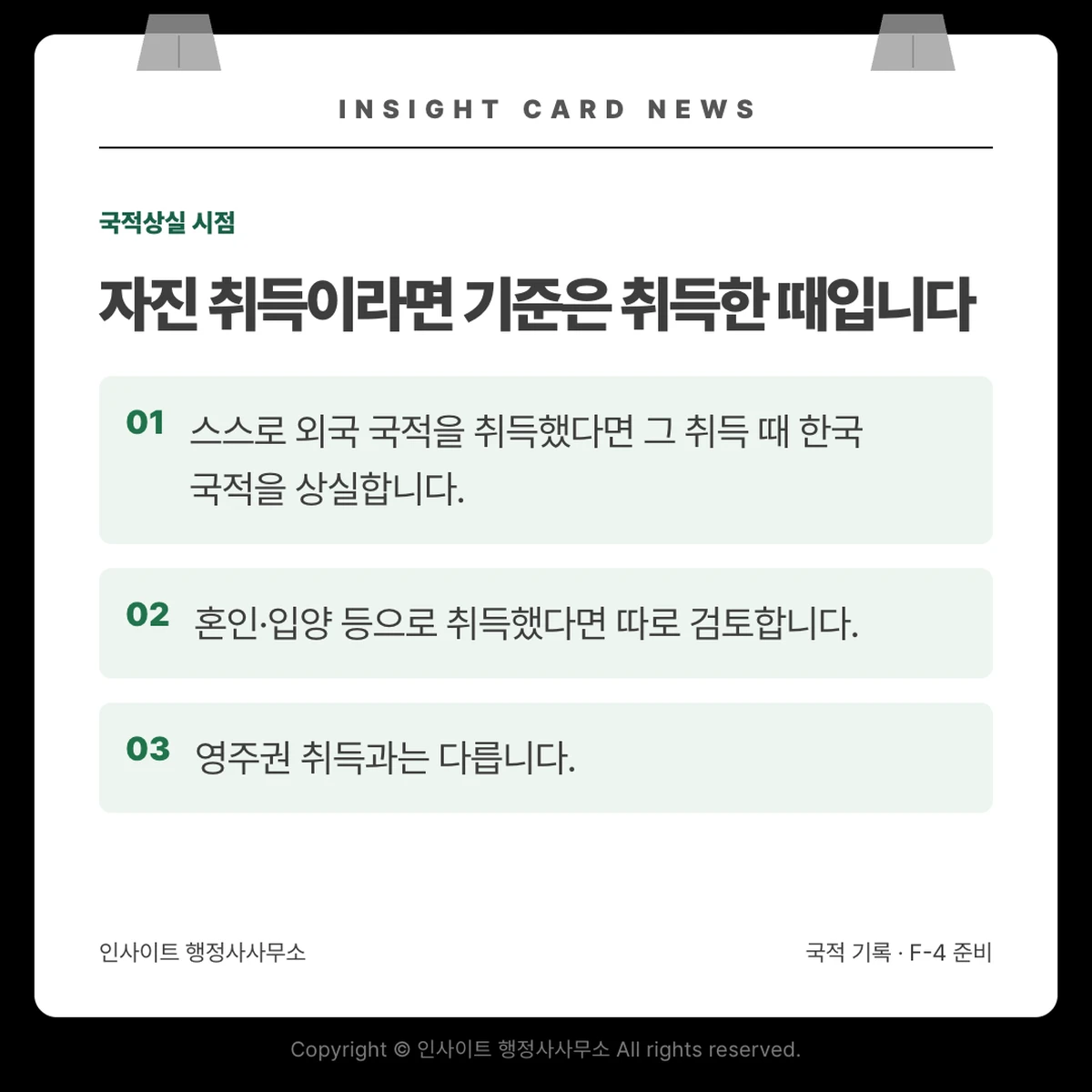
If you acquired a foreign nationality voluntarily, your Korean nationality should be treated as already lost, even if you have not reported it.
Article 15(1) of the Nationality Act provides that a national of the Republic of Korea who voluntarily acquires a foreign nationality loses Korean nationality at the time of acquiring that foreign nationality.
The reference point is the time you acquired the foreign nationality, not the date you report it.
Therefore, you cannot treat yourself as still being a Korean national, or as having naturally become a dual national, because you have not reported it.
However, not every acquisition of a foreign nationality is handled the same way.
Permanent residence is not a foreign nationality, so receiving permanent residence alone does not trigger this provision.
Cases where a foreign nationality was acquired through marriage, adoption or acknowledgment, or acquired as a minor together with a parent, are governed separately by Article 15(2) of the Nationality Act.
In those cases, it must be examined separately whether, among other things, a report of retention of nationality was filed within six months after acquiring the foreign nationality.
Multiple nationality from birth, where a person holds two nationalities from the time they are born, is a different matter again.
Article 16 of the Nationality Act imposes a reporting obligation on persons who have lost their nationality.
It also requires the Ministry of Justice to notify the family relationship registration office and the resident registration office of the loss of nationality.
How delaying the report affects F-4 preparation is covered separately in Preparing for the F-4 when the loss of nationality has not been reported.
Is what people call “giving up nationality” loss of nationality or renunciation of nationality?
In everyday speech both are called “giving up nationality,” but the law sets out two different types of report: the report of loss of nationality and the report of renunciation of nationality.
A person who has already lost Korean nationality by voluntarily acquiring a foreign nationality files a report of loss of nationality, while a multiple national who wishes to give up Korean nationality files a report of renunciation of nationality.
Under Article 14 of the Nationality Act, a multiple national with an address abroad files a report of renunciation through the Korean diplomatic mission with jurisdiction over that address.
Korean nationality is then lost when the Minister of Justice accepts the report.
Holding foreign citizenship does not mean everyone is subject to renunciation of nationality.
For men, there are separate periods and requirements related to military service, so you should first check which procedure applies to you.
How is a name changed at naturalization different from a name change in Korea?
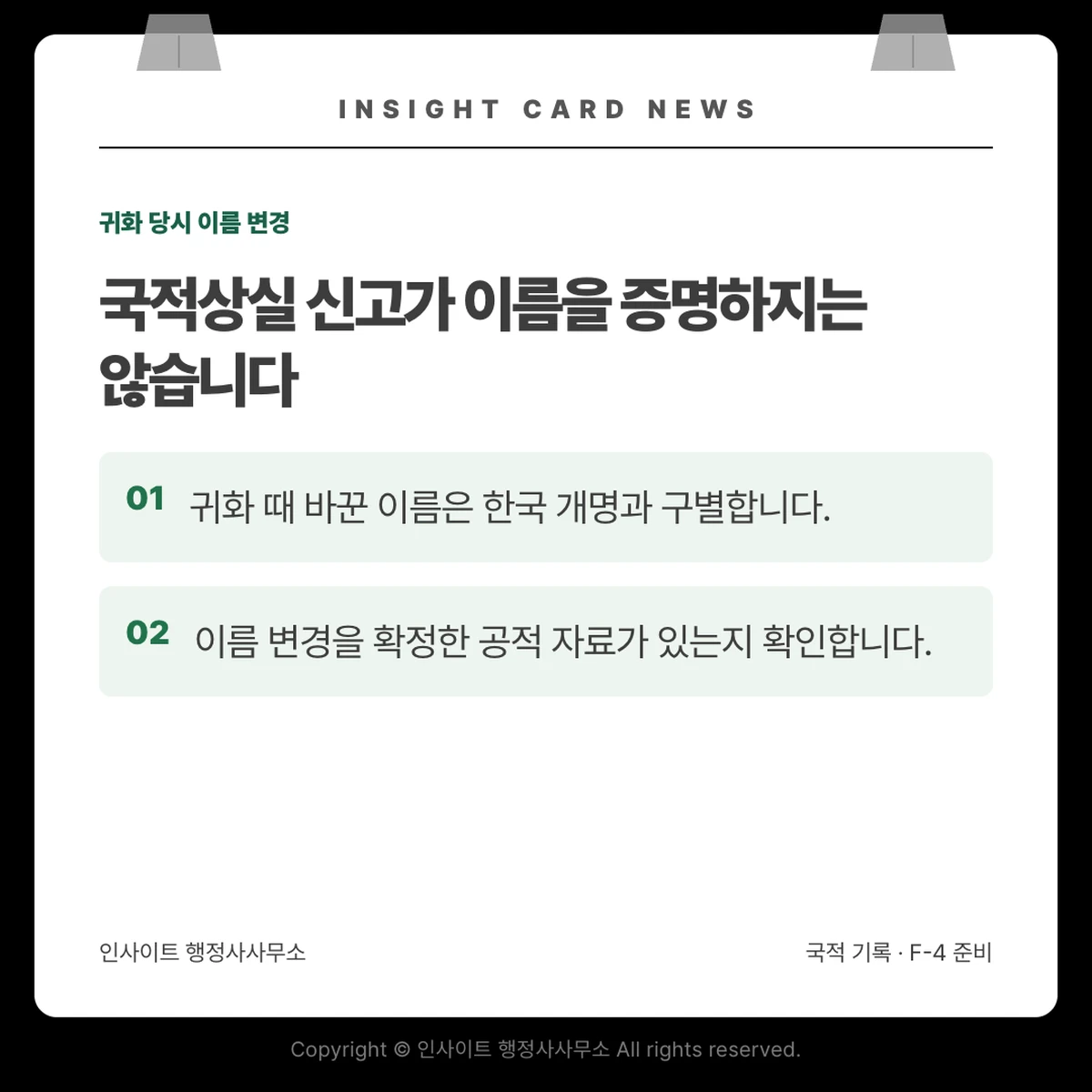
Choosing a new English name at naturalization is a name change made abroad, so the records to check differ from those for a separate name change in Korea.
If you changed your name in Korea, that fact is recorded in your Korean family relationship records.
By contrast, if you changed your name during naturalization, your Korean records still show your Korean name, and how the name changed must be shown through foreign documents.
In the United States, a court can process a name change as part of naturalization.
The official self-help guide of the California courts also explains cases where a name is changed together with acquiring citizenship.
In such cases, check whether there is a document in which the court finalized the name change.
If you have documents related to a name change request, such as a Petition for Name Change, check whether the document states that the court approved the change.
You cannot assume that a petition alone, without approval, proves the name change.
Name change evidence is not issued to all U.S. citizens in the same format.
There is also no single nationwide authority that reissues these records, so first identify the region and authority where the name was changed.
In addition, reporting the loss of nationality does not automatically prove the name change.
The key is to show, through official records, that your Korean name, your name at naturalization and your current passport name belong to the same person.
Not everyone needs to start with a name change procedure in Korea, so first check whether the documents you have now connect the three names.
What does each document do?
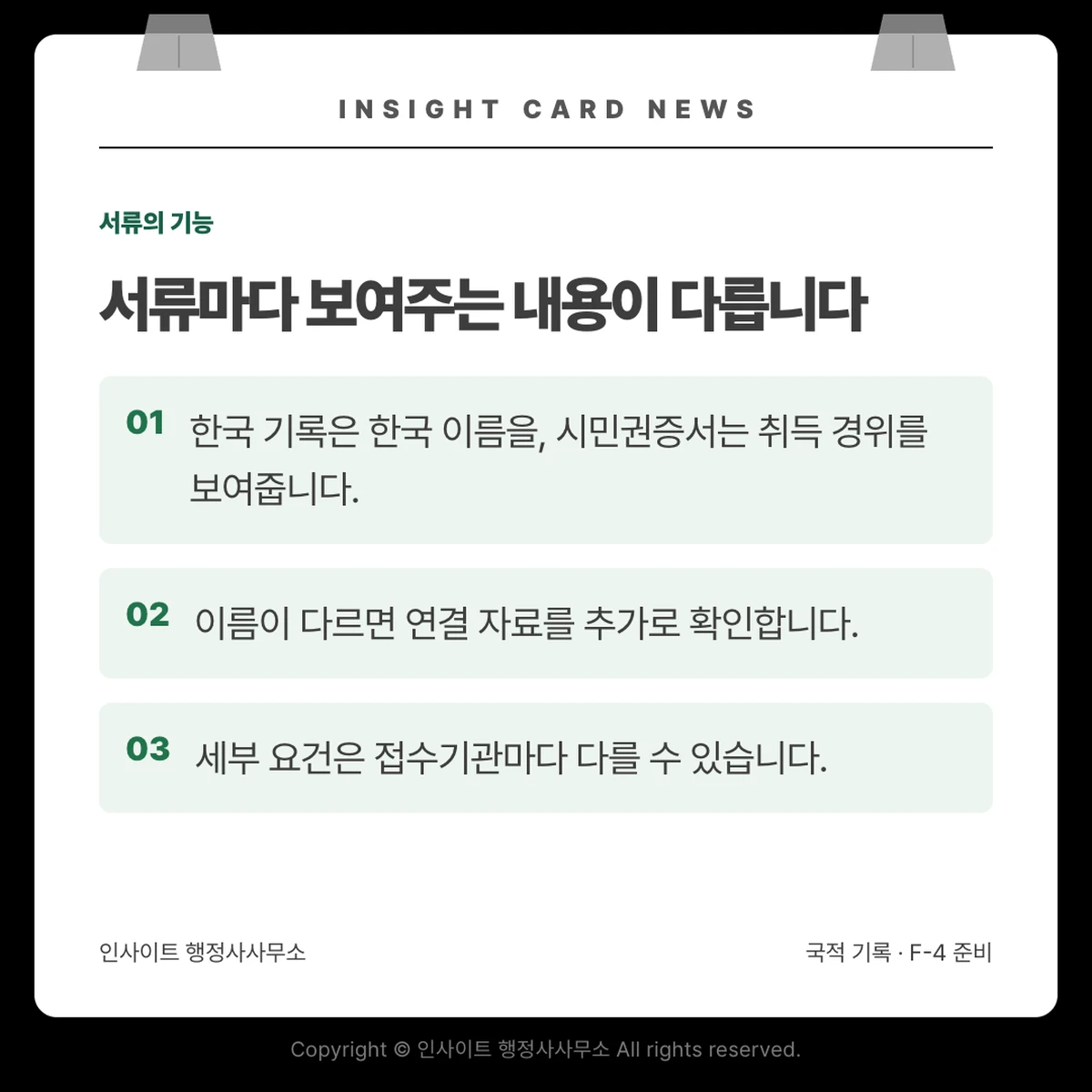
The documents used for reporting loss of nationality and for linking names each prove different things, so prepare them based on their function rather than their titles.
Article 14 of the Enforcement Rules of the Nationality Act requires a certificate of family relationship records to be attached to the report of loss of nationality in Form No. 10.
It also requires a document proving the cause and date of acquisition of the foreign nationality, and a copy of the foreign passport, to be submitted together.
| Document | What it shows | What to check |
|---|---|---|
| Report of loss of nationality | Reporting the fact of loss of nationality | Check the receiving office’s guidance on which name to enter |
| Certificate of family relationship records | Name and date of birth in Korean records | Which type of certificate the receiving office requires |
| Proof of acquisition, such as a citizenship certificate | Cause and date of acquiring the foreign nationality | Whether the acquisition date is stated; name at naturalization |
| Copy of foreign passport | Current nationality and current name | Whether it matches the name on the citizenship certificate |
| Name change evidence | How the name changed at naturalization | Whether it is a document finalized by a court or other authority |
| Same-person confirmation in the receiving office’s form | Who confirms and signs, and the supporting evidence required | Whether it is meant to supplement official records |
The Enforcement Rules also provide that, if a document proving the date of acquisition cannot be submitted, a copy of the foreign passport may be submitted instead.
In addition, Article 15(3) of the Nationality Act provides that, if the date of acquiring the foreign nationality is unclear, the foreign nationality is presumed to have been acquired on the date the foreign passport was first issued.
This does not mean, however, that any passport will be processed immediately if you do not have a citizenship certificate.
Which materials can be used instead must be confirmed under the receiving office’s standards.
How do diplomatic missions actually explain this?
Diplomatic mission guidance also asks for additional documents showing how the name changed when the names differ.
As an example from Canada, the guidance of the Consulate General in Vancouver states that the name on the report should be the name recorded in the Korean family relationship register.
The documents it lists are the basic certificate, the family relationship certificate (detailed), a citizenship certificate showing the acquisition date, a passport and a photo.
If the names differ, it asks for a same-person confirmation, together with a certificate of name change if you have one, and if your surname changed through marriage, it asks for a marriage certificate.
The FAQ of the Embassy in Singapore also states that if the names differ, you should submit a Name Change Certificate and a same-person confirmation, and enter your Korean name on the report.
However, detailed requirements such as the validity period of documents, signing methods and mail submission may differ by mission.
It is safer to treat the above as regional examples and not to apply them as common standards for all regions.
In what order should I prepare?
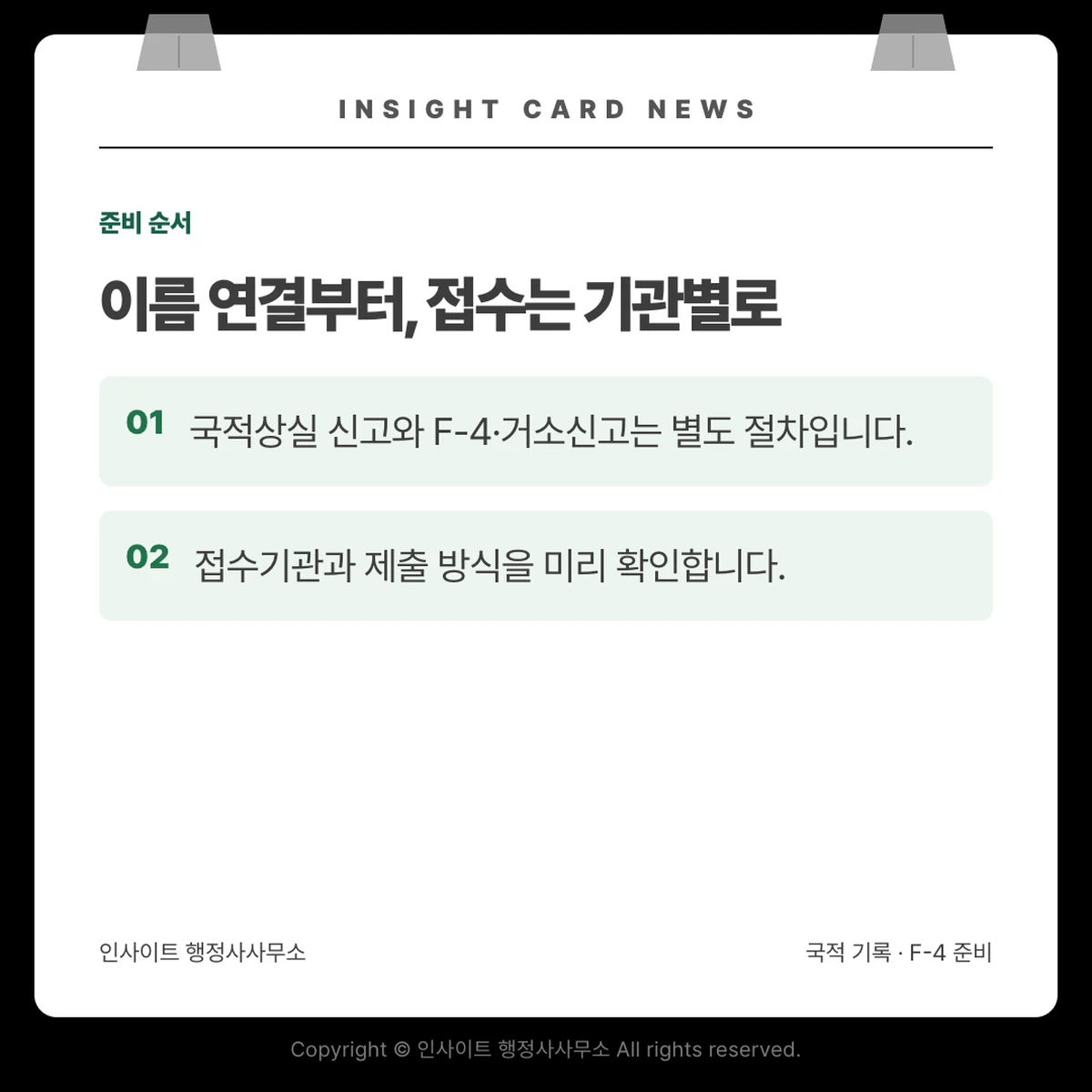
It is safer to check the name-linking documents first, and then proceed with the report of loss of nationality and the F-4 preparation according to each office’s filing standards.
- Check Korean records: Confirm your Korean name and date of birth with your basic certificate or similar documents.
- Check how you acquired the nationality: Confirm whether you acquired it voluntarily or for another reason such as marriage or adoption, and when you acquired it.
- Check the name change documents: Find out whether there is a document that finalized the name change at naturalization, and if not, which authority can reissue it.
- Check the receiving office: Abroad, check the Korean diplomatic mission with jurisdiction; in Korea, check in advance which immigration office accepts nationality matters.
- Prepare for the F-4 and residence report: Separately from settling the report of loss of nationality, prepare the documents for the F-4 visa or the residence report.
Even if you file in Korea, you cannot assume that every branch office handles nationality matters, so check before visiting.
Whether an appointment is required, how originals are verified and how translations must be certified may also differ by office.
Settling the report of loss of nationality and the F-4 and residence card review are separate procedures, and whether both can be filed at once also needs to be checked with each office.
How to prepare both procedures together is explained in Preparing the report of loss of nationality and the F-4 in parallel.
When should I have a professional review my case?
If your name has changed more than once, or the timing and circumstances of your acquisition of nationality are unclear, it is better to have the links between your records reviewed before you obtain documents.
- Your surname changed again through marriage or similar after you changed your name at naturalization
- Your citizenship certificate does not show the acquisition date, or you have lost the certificate
- It is unclear whether your foreign nationality was acquired voluntarily or for another reason
- You have not decided whether to file with a diplomatic mission abroad or an immigration office in Korea
Even for the same name change at naturalization, the documents to check differ depending on which country and which authority processed it.
That is why a review is needed that lines up the documents while considering your names, the time you acquired the nationality and the receiving office together.
When you consult an F-4 administrative agent, the review will go more smoothly if you bring documents showing your Korean name, your name at naturalization and your current passport name.
Article 25-2(1) of the Enforcement Decree of the Nationality Act sets the principle that nationality-related reports for persons aged 15 or older must be filed by the person themselves.
However, a report of loss of nationality may be filed on the person’s behalf by a spouse or a relative within the fourth degree, in which case a document proving the relationship to the reporting person must be submitted as well.
This provision does not mean that an administrative agent can file reports of loss of nationality on someone’s behalf across the board, and whether in-person or mail submission is possible should be confirmed through the guidance of the office where you will file.
The scope of what an administrative agent can handle also differs by procedure; the scope for residence card matters is set out in Scope of residence card agency services.
If you are worried about documents with different names before visiting an immigration office, one option is to have an immigration administrative agent check how your documents are put together first.
If you would like your naturalization name change documents reviewed
Please tell us your Korean name on your basic certificate, the name and acquisition date on your citizenship certificate, your current passport name and when your name changed.
Insight Administrative Agent Office reviews documents related to the F-4 and reports of loss of nationality, and explains the name-linking documents and what each receiving office requires separately.
Acceptance of a report and visa or residence card outcomes are decided by each authority, so our review focuses on making sure the documents needed for that decision are complete.
If you were looking for an administrative agent in Seoul or Songpa, in-person consultations are also available at our Munjeong-dong office.
Planning a visit to the Seoul Immigration Office headquarters?
The Seoul Immigration Office began operating at its new building at 55 Jeongui-ro, Songpa-gu, Seoul on October 19, 2026, and the former Mokdong building no longer provides services.
If you plan to visit what is commonly called the Seoul Immigration Office headquarters, first check whether that office handles the matter you want to file, whether it has jurisdiction and whether a visit appointment is required.
The address for in-person consultations at Insight Administrative Agent Office is below.
Insight Administrative Agent Office, Representative Administrative Agent Yoon Somang
Address: A-110, 1F, 25 Beobwon-ro 11-gil, Songpa-gu, Seoul (Munjeong-dong, H Business Park)
Phone: 010-2476-7110
KakaoTalk: Consult via Open Chat