
Hello.
I am Yoon Somang, Representative Administrative Agent at Insight Administrative Agent Office.
“I received U.S. citizenship a long time ago, but I never reported anything to Korea. Can I apply for a residence card in this situation?”
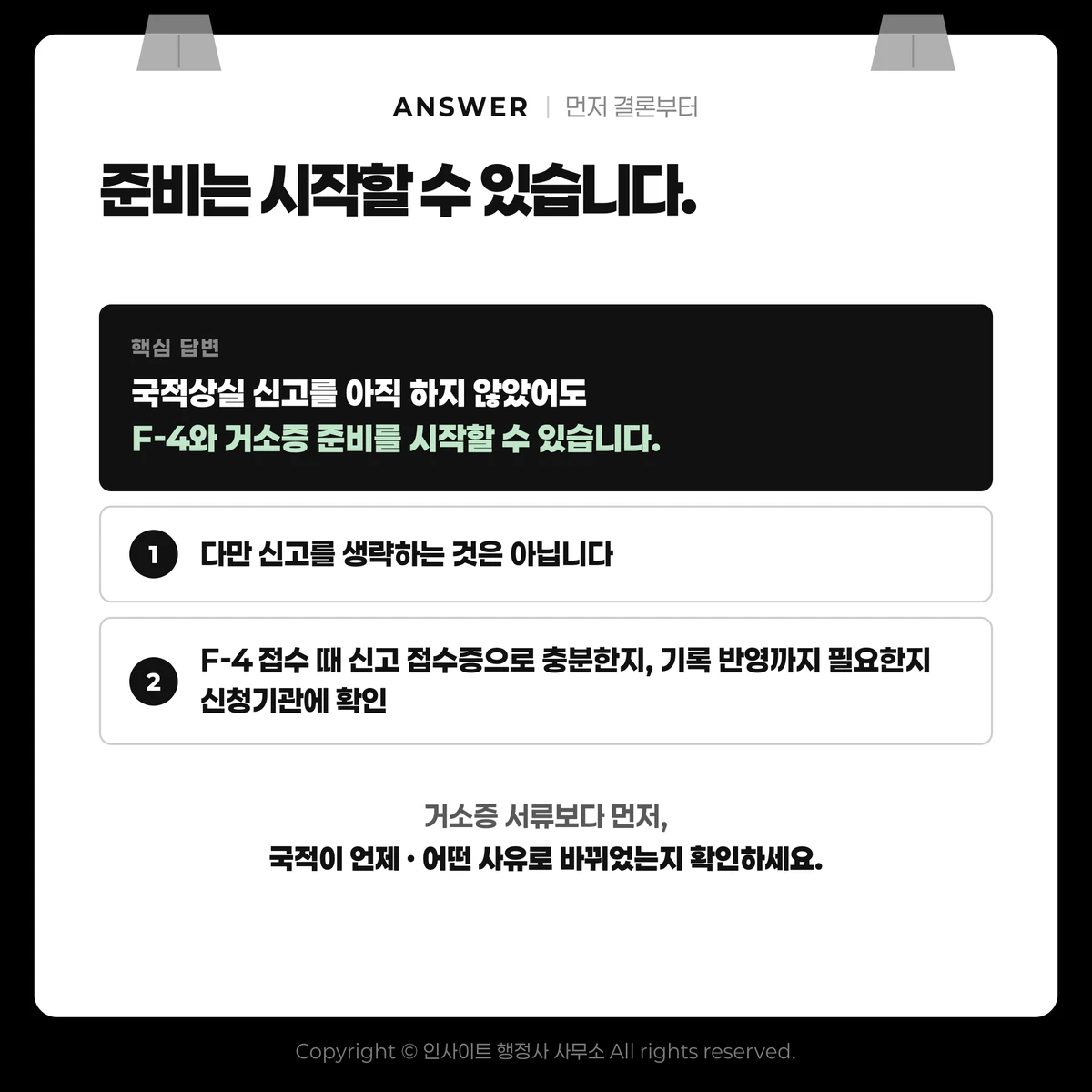
This question requires checking both whether loss of nationality has been reported and whether an F-4 application is possible.
Even if you have not yet reported loss of nationality, you can begin preparing for F-4 and a residence card.
However, this does not mean the report can be skipped.
You need to file the nationality loss report and confirm with the application authority whether, at the time of F-4 filing, the report receipt is sufficient or whether the loss must already be reflected in the records.
That is why, before gathering residence card documents, you should first confirm when and for what reason your nationality changed.
If I Have Not Reported It, Am I Still a Korean National?
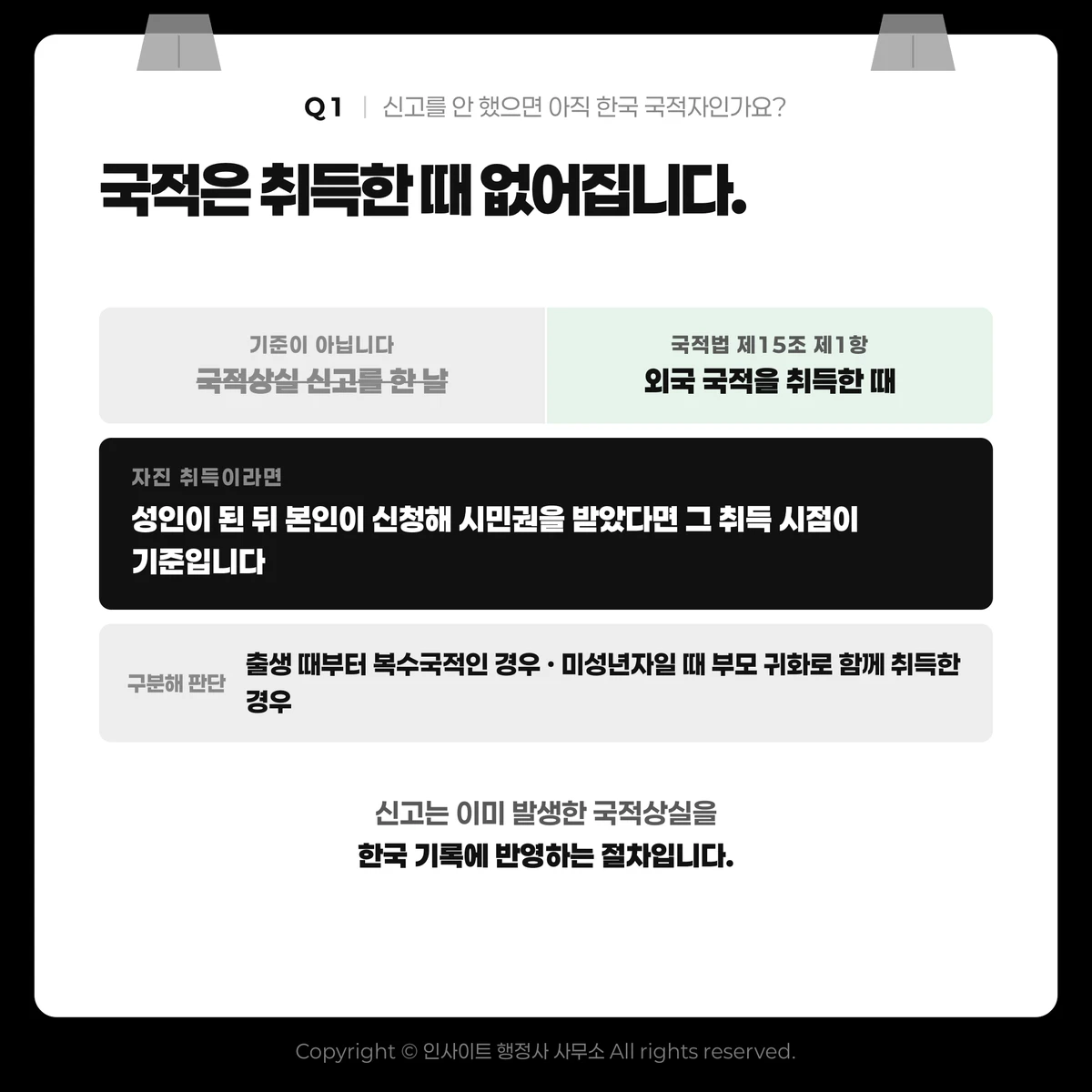
If you voluntarily acquired a foreign nationality, you lose Korean nationality at the time you acquired the foreign nationality.
This is provided in Article 15(1) of the Nationality Act.
Your nationality does not cease on the date you file the nationality loss report.
For example, if you applied for and received U.S. citizenship yourself after becoming an adult, the time you acquired that citizenship is the reference point.
You can understand the report as a procedure for reflecting in Korean records a loss of nationality that has already occurred.
However, this principle should not be applied to everyone in the same way.
Cases where a person held both Korean and foreign nationality from birth are assessed separately from voluntary acquisition.
Cases where a person acquired a foreign nationality as a minor when their parents naturalized must also be checked separately.
The procedures you need afterward differ depending on which case applies to you.
Then Do I Not Need to Report It?
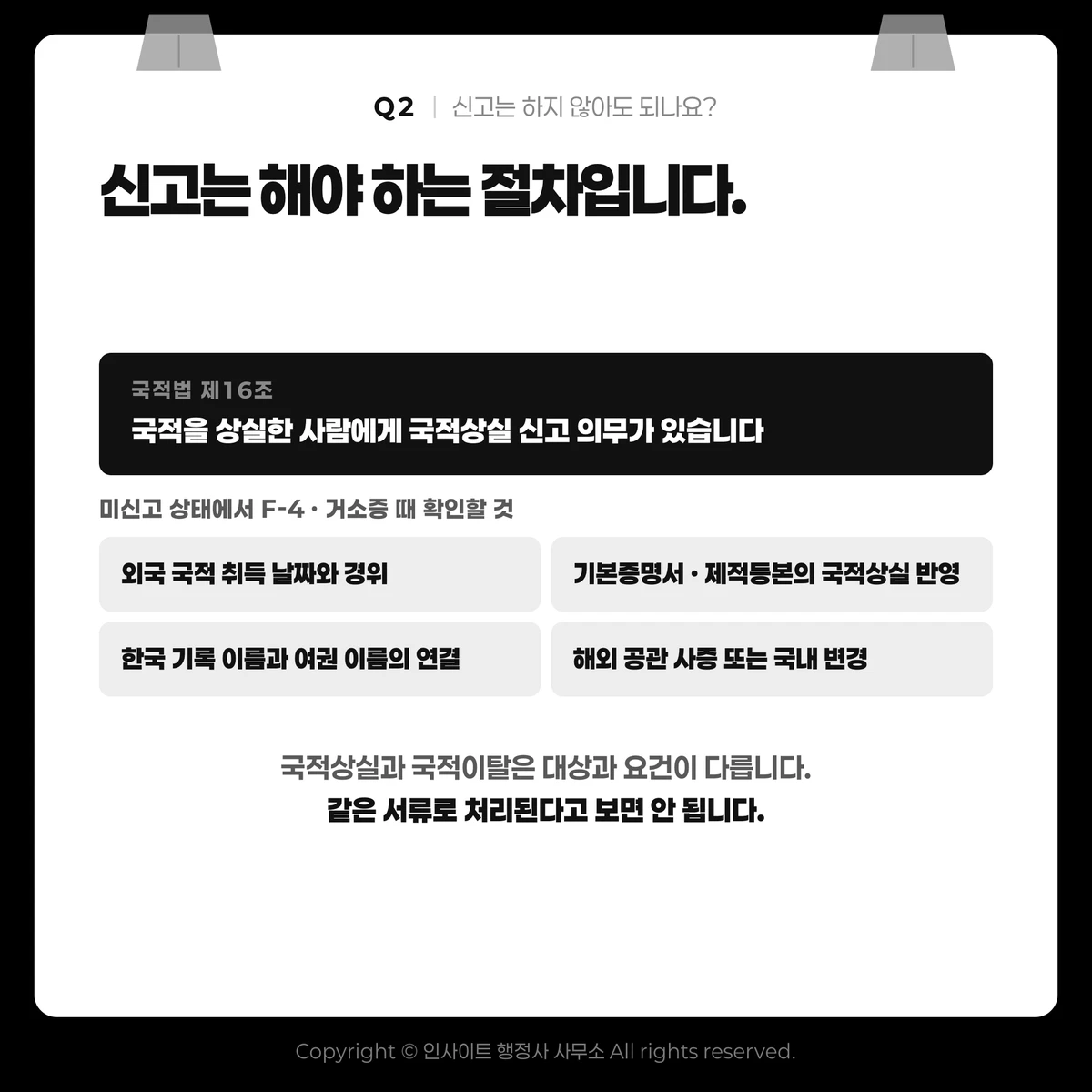
The nationality loss report is a required procedure.
Article 16 of the Nationality Act imposes a duty on a person who has lost nationality to report the loss of nationality.
You should also distinguish between loss of nationality and renunciation of nationality.
Loss of nationality refers to cases where Korean nationality ceased for reasons such as voluntarily acquiring a foreign nationality.
Renunciation of nationality is a separate procedure in which a multiple national files a report to give up Korean nationality.
The two procedures differ in who they apply to and their requirements, so you should not assume they can be handled with the same documents.
How Does Not Having Reported Affect a Residence Card Application?
Because F-4 and the residence card are procedures premised on the applicant being a foreign national of Korean descent, if Korean records and foreign nationality documents do not match, it is difficult for the reviewing authority to promptly confirm the applicant’s nationality status.
A typical case is when the certificate of citizenship shows acquisition of a foreign nationality, but the Korean Basic Certificate does not show loss of nationality.
In this situation, check the following.
- The date and circumstances of acquiring the foreign nationality
- Whether loss of nationality is reflected in the Basic Certificate or the removed family register (jejeok deungbon)
- Whether the name in Korean records can be linked to the name in the current passport
- Whether you will obtain a visa at an overseas mission or change your status of stay in Korea
If the names differ, documents proving you are the same person may be needed in addition to settling your nationality.
Basic preparation items for former Korean nationals can also be found in F-4 Applications for Foreigners Who Have Lost Korean Nationality.
Can I Apply for F-4 with the Nationality Loss Report Receipt?
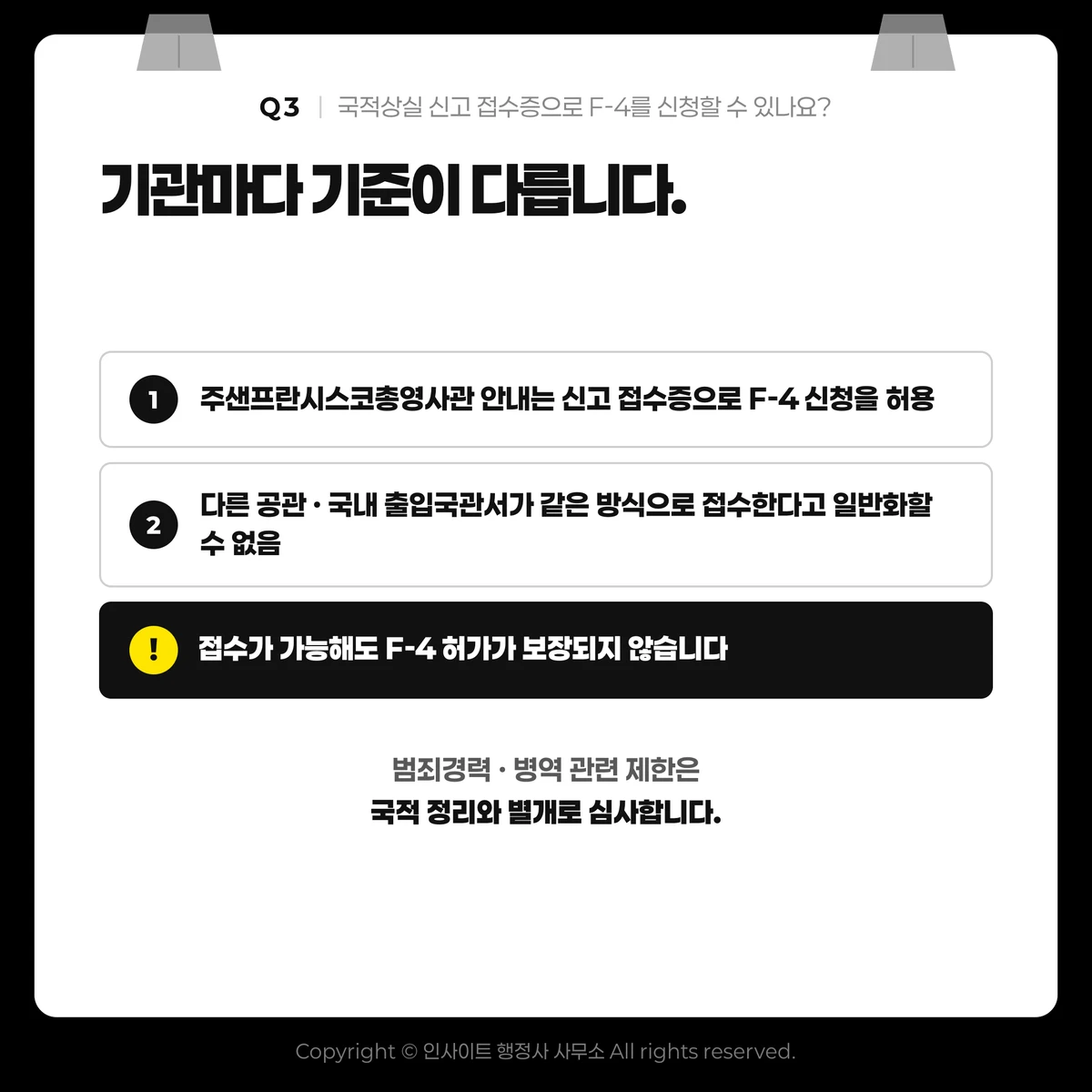
Some overseas missions allow it, but it cannot be assumed that the same standard applies at every receiving authority.
The F-4 guidance of the Consulate General in San Francisco allows applications with a nationality loss report receipt.
However, this is the guidance of that particular mission.
It cannot be generalized that other missions or immigration and foreign affairs offices within Korea accept applications in the same way.
Even if your application is accepted, F-4 approval is not guaranteed.
This is because there are matters reviewed separately from nationality settlement, such as criminal records and restrictions related to military service.
How the nationality loss report and F-4 documents can be prepared together, and in what order, is explained further in How to Prepare the Nationality Loss Report and F-4 Application Together.
If I Am in Korea, Can I Change Status Domestically Right Away?
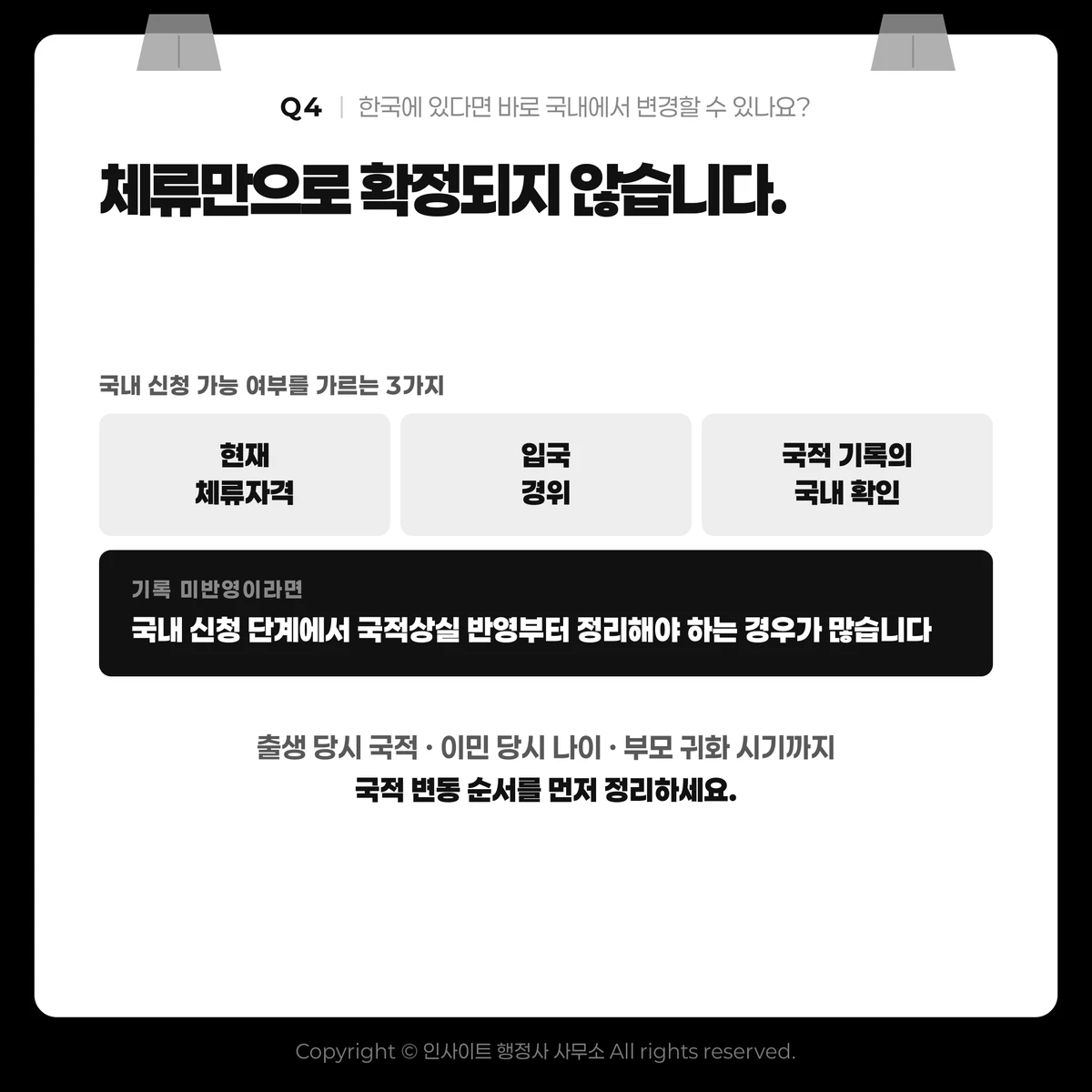
Being in Korea alone does not confirm that you can change status domestically.
Whether you can apply domestically depends on your current status of stay, how you entered Korea, and whether your nationality records can be confirmed in Korea.
If the loss of nationality is not reflected in Korean records, in many cases this must be resolved first at the domestic application stage.
Please check the conditions in How to Change to F-4 Within Korea.
Determining when nationality was lost may in some cases require looking at your nationality at birth, your age at the time of immigration, and when your parents naturalized.
If your records are old or you immigrated through several countries, it is safer to first organize the sequence of nationality changes with an immigration administrative agent before obtaining documents.
If You Would Like a Consultation Before Reporting Loss of Nationality
Please let us know the date you acquired foreign nationality, your age at the time of immigration, whether your parents’ nationality changed, your current country of residence, and your plans for entering Korea.
Insight Administrative Agent Office provides consultations that distinguish whether a nationality loss report is needed first and to which authority you can submit your F-4 application.
If you have a copy of your Basic Certificate or certificate of citizenship, sending it along will allow us to give more specific guidance on what needs to be checked.