
Hello.
I am Somang Yoon, Representative Administrative Agent of Insight Administrative Agent Office.
Some people find out late that they have not yet filed a nationality loss report, even as their date of entry into Korea approaches.
The question they most often ask at this point is: “Do I have to wait until the nationality loss report is finished, or can I proceed with the F-4 at the same time?”
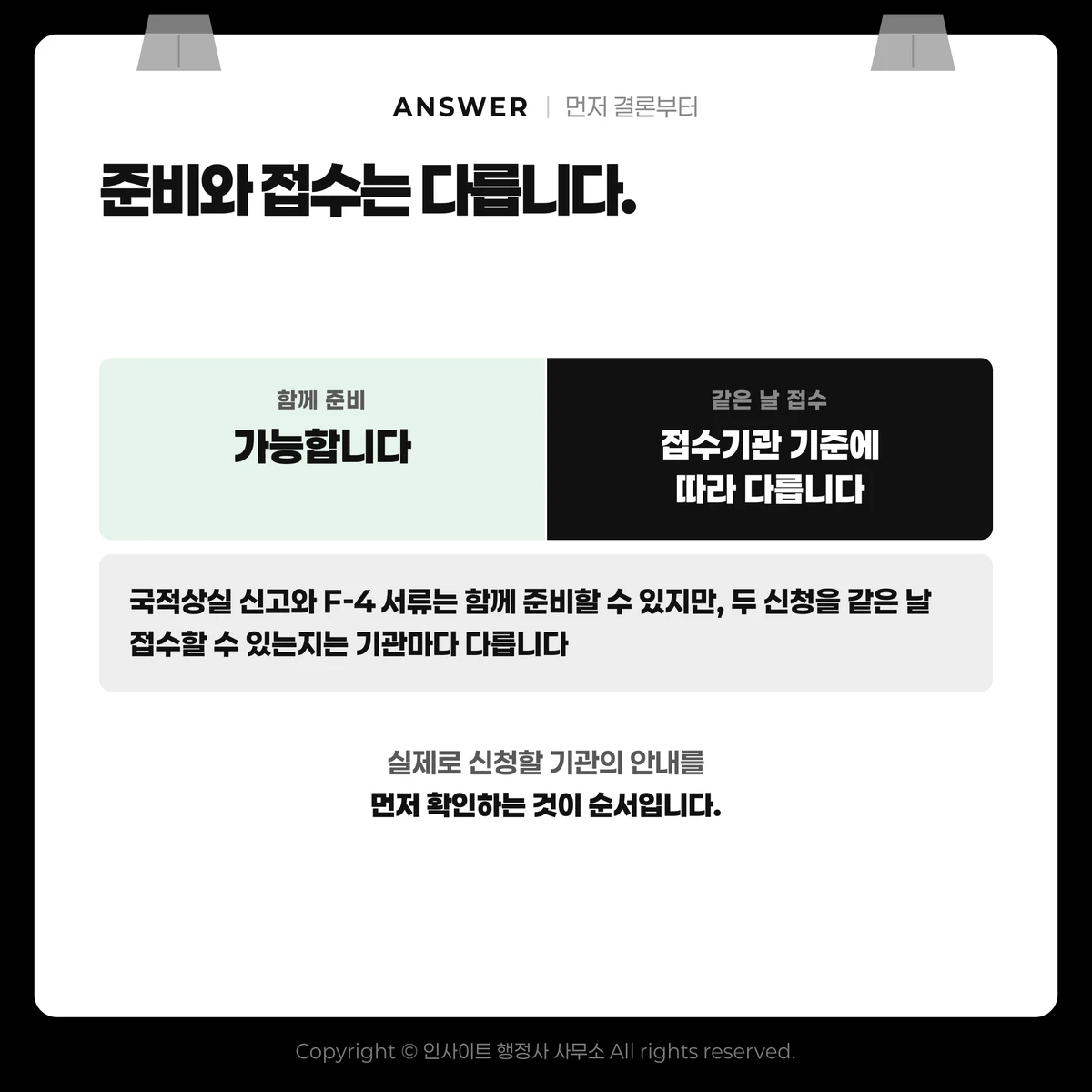
You can prepare the nationality loss report and the F-4 documents together, but whether both can be filed on the same day depends on the standards of the receiving office.
In this article, I will explain separately which parts can be prepared at the same time and which parts must be checked with each office.
How are the nationality loss report and the F-4 related?
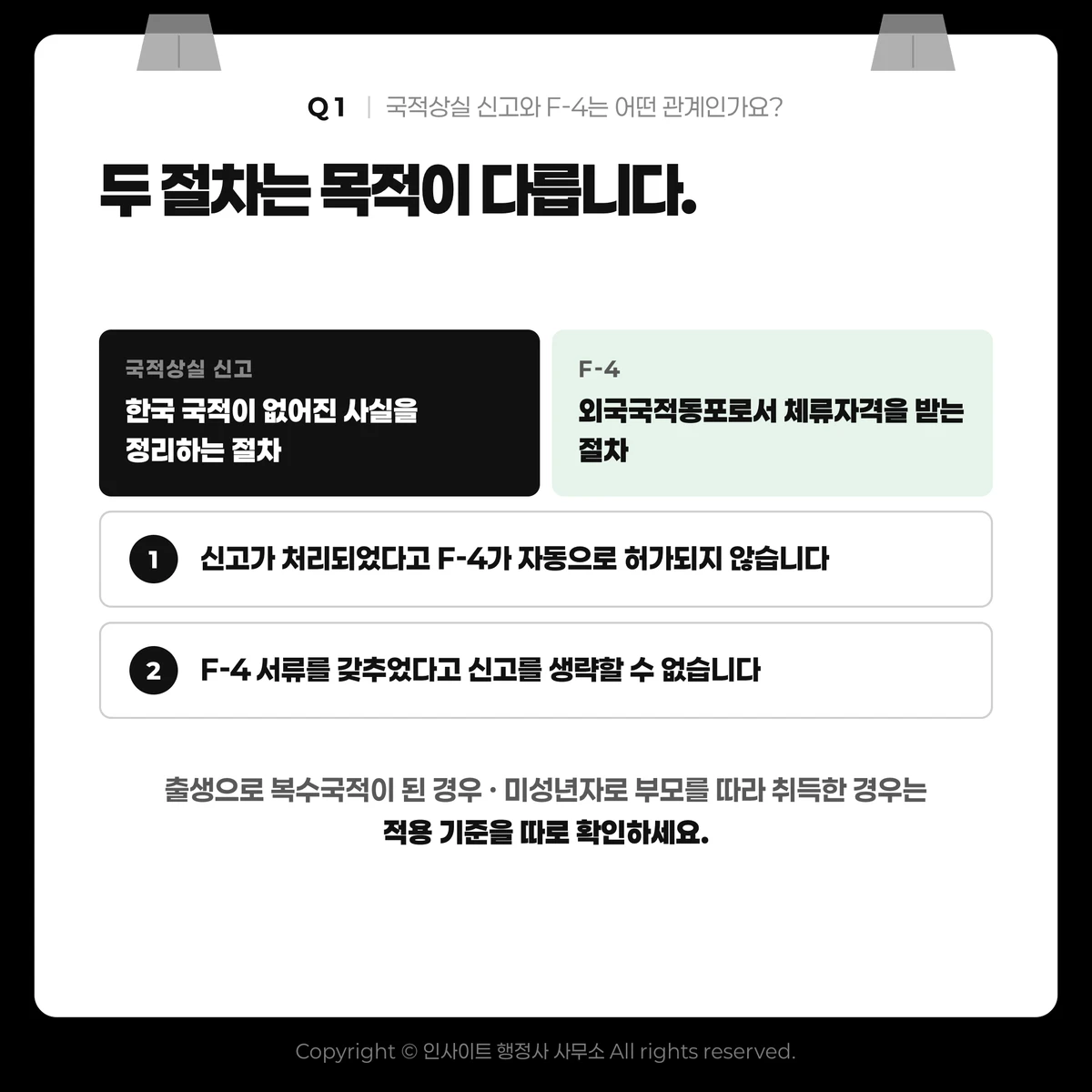
The nationality loss report is a procedure for formally recording the fact that you no longer hold Korean nationality, while the F-4 is a procedure for obtaining a status of stay as a foreign national of Korean descent.
Under Article 15(1) of the Nationality Act, a person who voluntarily acquires a foreign nationality loses Korean nationality at the time of acquiring the foreign nationality.
Article 16 of the Nationality Act imposes a reporting obligation on persons who have lost their nationality in this way.
The two procedures have different purposes.
Having your nationality loss report processed does not mean the F-4 is automatically granted.
Conversely, having your F-4 documents in order does not mean you can skip the nationality loss report.
If you became a multiple national by birth, or acquired a foreign nationality as a minor along with your parents, the applicable standards must be checked separately.
If it is still unclear whether a report has been filed, please first read Applying for a residence card when you have not filed a nationality loss report.
Which documents can be prepared together?
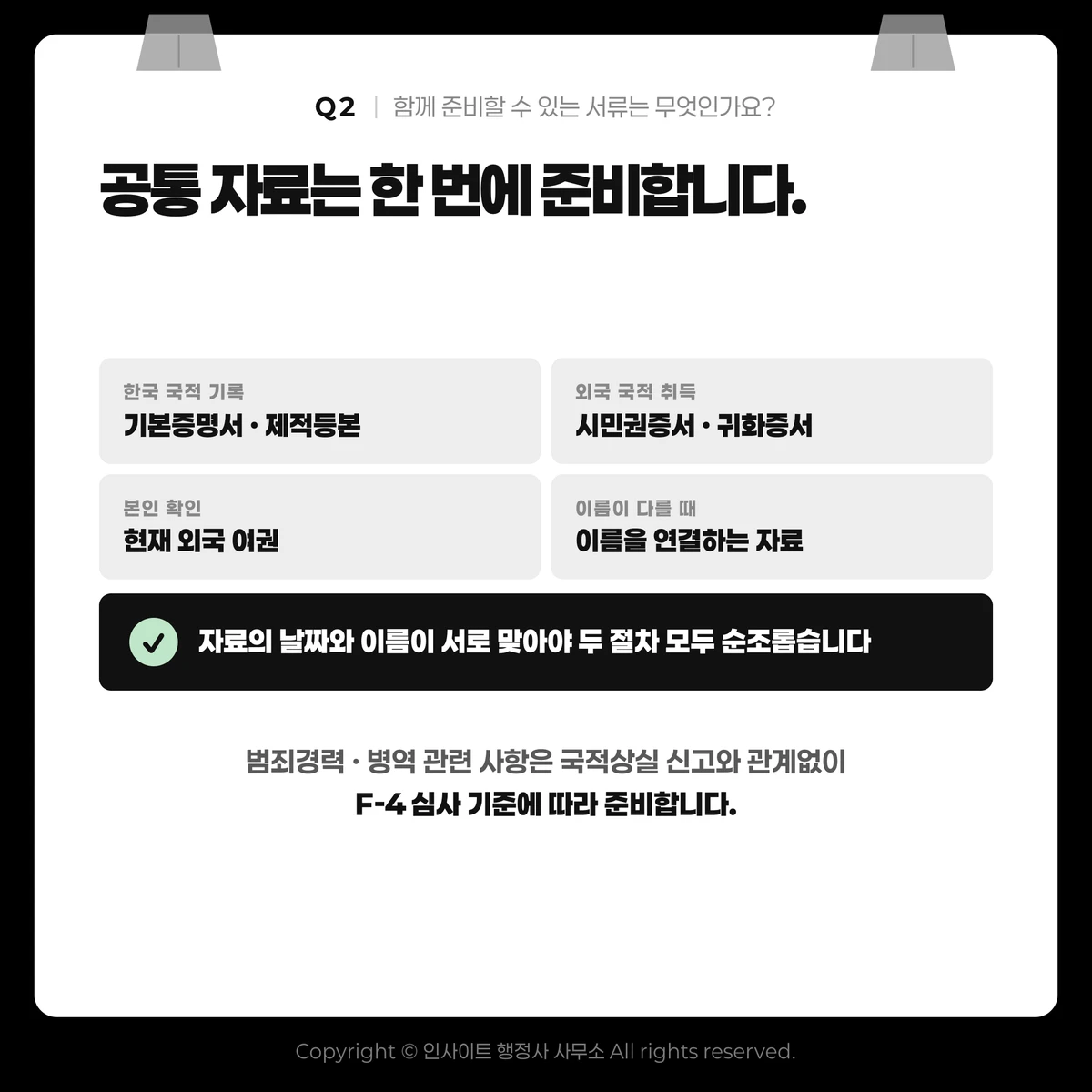
Both procedures are based on your Korean nationality records, proof of foreign nationality acquisition, and identity documents, so much of the preparation can be done at once.
Typically, the following documents are checked together:
- Records of your former Korean nationality, such as the Basic Certificate and the certified copy of the removed family register
- Proof of foreign nationality acquisition, such as a certificate of citizenship or certificate of naturalization
- Your current foreign passport
- Documents linking your names if your Korean name and foreign name differ
The dates and names in these documents must match each other for both procedures to proceed smoothly.
If the name in your Korean records differs from the name on your certificate of citizenship, please also check Preparation when your name differs between your citizenship and Korean documents.
In addition to nationality documents, the F-4 involves items that are checked separately, such as criminal records and military service matters.
These are prepared according to the F-4 review standards, independently of the nationality loss report.
The full set of documents is summarized in How to apply for the F-4 and required documents.
Can they be filed on the same day?
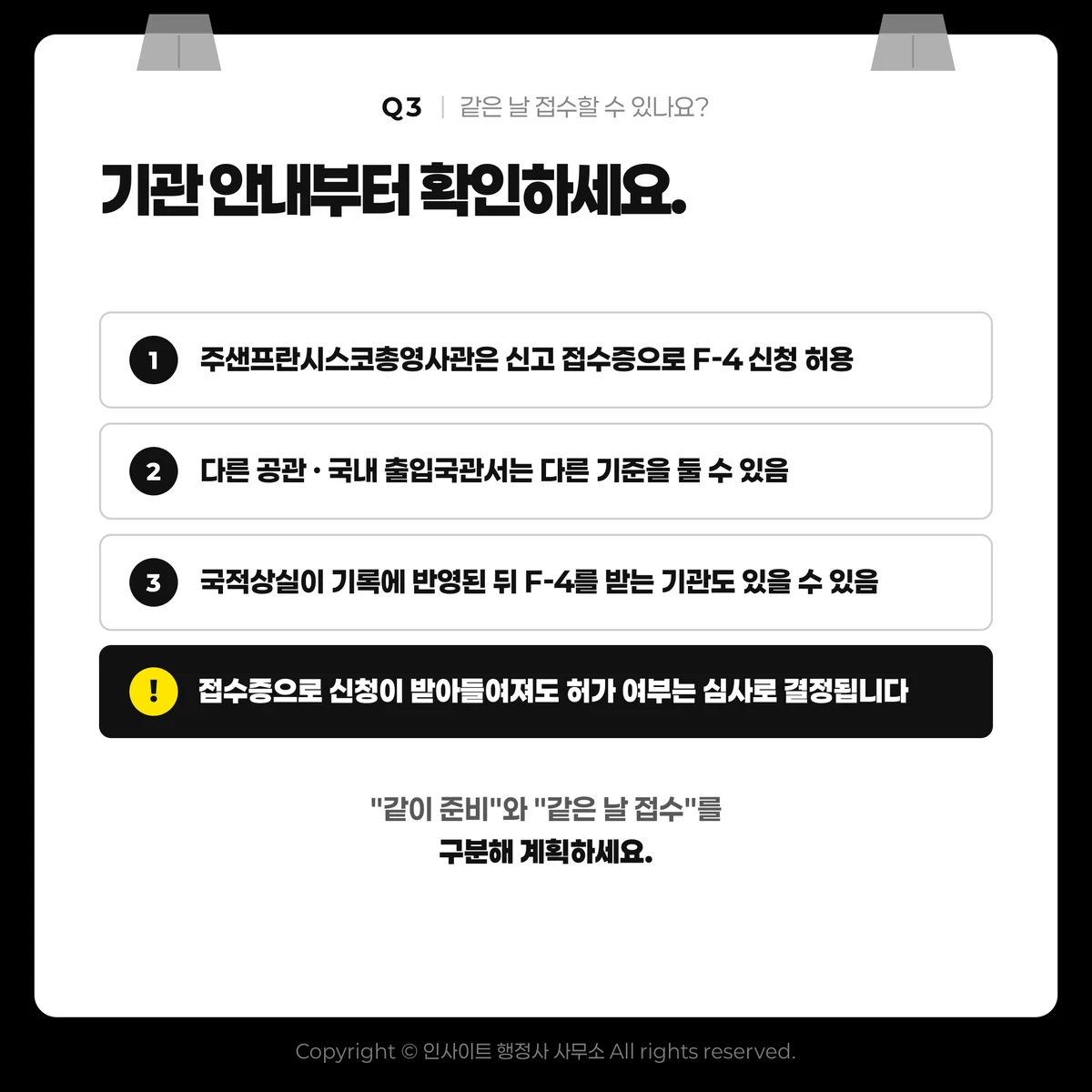
Some missions accept an F-4 application with a nationality loss report receipt, but this cannot be treated as the standard for all offices.
The F-4 guide of the Consulate General of the Republic of Korea in San Francisco allows applicants to apply with a nationality loss report receipt.
At missions like this, you can shorten the timeline by first filing the nationality loss report and then including that receipt in your F-4 documents.
However, other missions or immigration offices in Korea may apply different standards.
Some offices may accept an F-4 application only after the loss of nationality has been reflected in Korean records.
Therefore, the proper order is to distinguish between “preparing together” and “filing on the same day,” and to first check the guidance of the office where you will actually apply.
Even if an application with a receipt is accepted, whether the visa is granted is decided through review.
Can a family member or an administrative agent file the nationality loss report on my behalf?
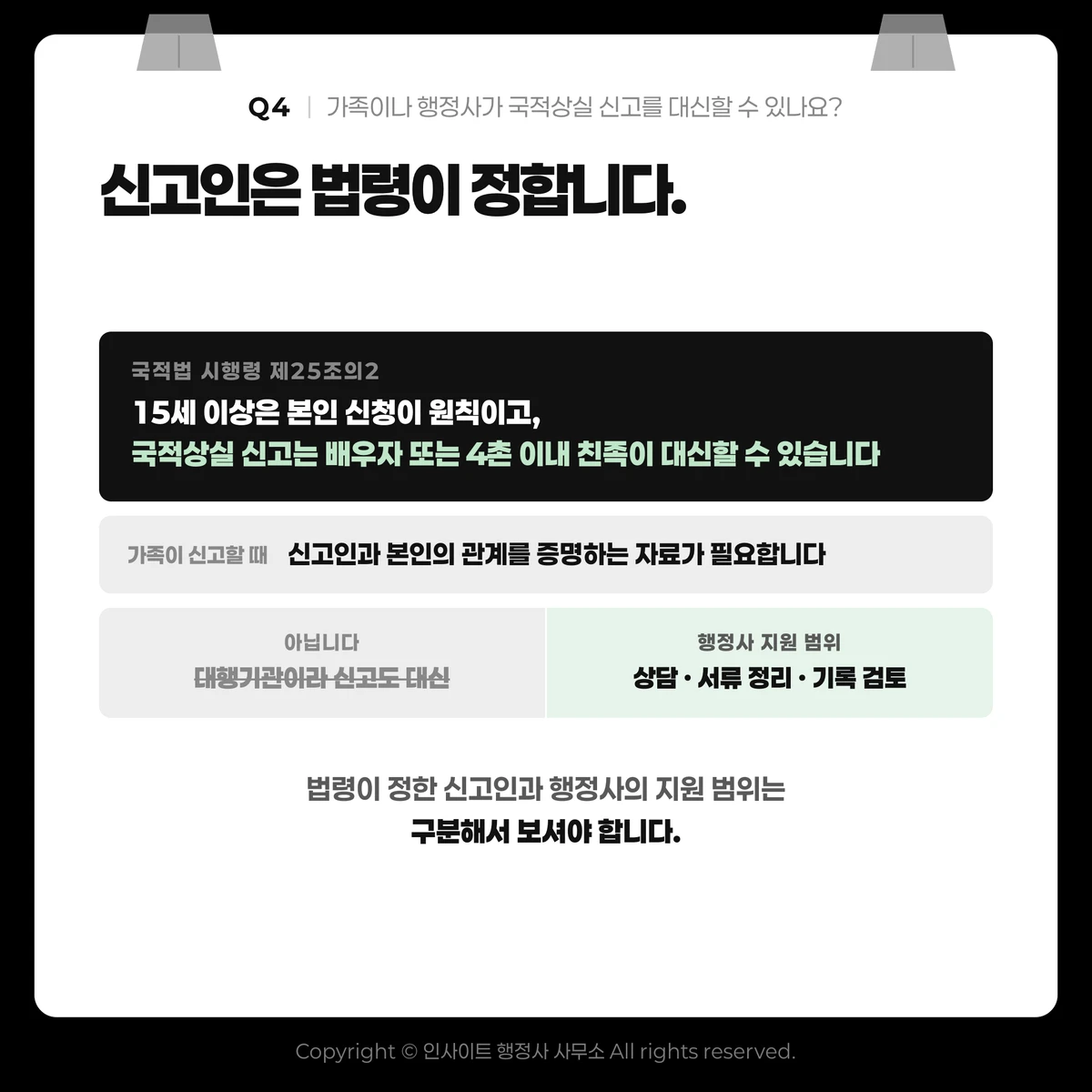
In principle, persons aged 15 or older apply in person, but a spouse or a relative within the fourth degree of kinship may file the nationality loss report on their behalf.
This is set out in Article 25-2 of the Enforcement Decree of the Nationality Act.
When a family member files on your behalf, documents proving the relationship between the filer and you are required.
If a sibling or parent in Korea intends to file on your behalf, these relationship documents should also be prepared in advance.
Being a registered immigration application agency does not by itself mean that the agency can also file a nationality loss report on your behalf.
What an administrative agent can handle is support with consultation, document organization, and record review.
You should keep separate who the law designates as an eligible filer and the scope of an administrative agent’s support.
Even if you prepare your F-4 through an administrative agent office in Seoul, where and by whom the nationality loss report can be filed depends on your country of residence and family situation.
Whether filing at an overseas mission or a proxy report by family members in Korea is possible needs to be reviewed before you apply.
If you would like to plan both procedures together
Consultation on the order of the nationality loss report and the F-4 ↗
Please let us know the date you acquired your foreign nationality, your current country of residence and the mission with jurisdiction, your family relationships in Korea, and your planned date of entry into Korea.
Insight Administrative Agent Office reviews the order in which the nationality loss report and the F-4 application can proceed, and organizes the documents used in common for both procedures.
After confirming filer eligibility and the mission’s standards, you can plan the actual schedule together with us.
Consult on nationality loss and F-4 preparation via KakaoTalk