
Hello.
I am Somang Yoon, Representative Administrative Agent at Insight Administrative Agent Office.
If you are taking time off to spend two or three weeks in Korea and want to get your residence card during that stay, what should you prepare first?
Some people book their flights first, then start checking documents and discover that they cannot finish everything within the remaining time.
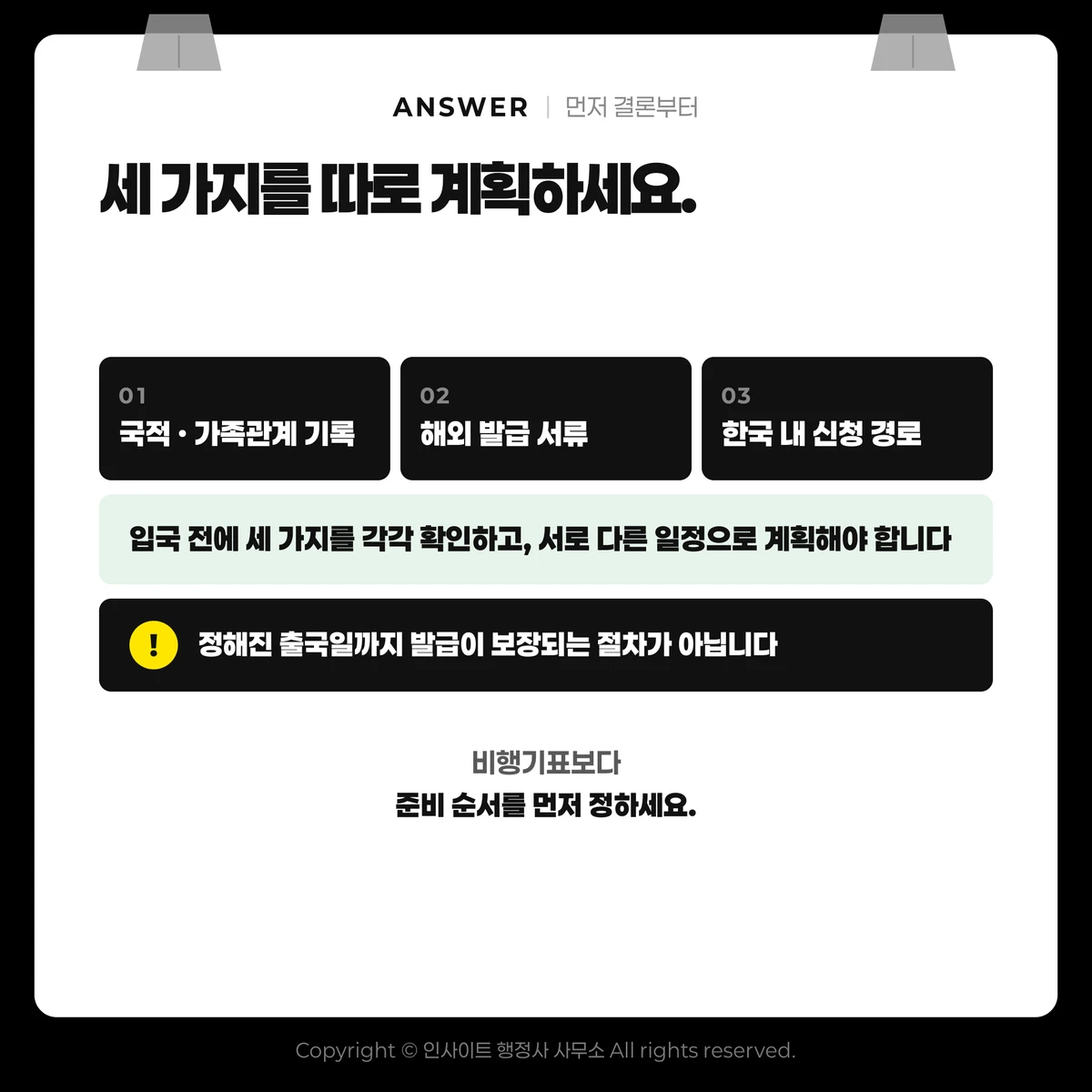
If you are going to Korea to get your residence card, before entering you need to check your nationality and family relation records, your overseas-issued documents, and your application route in Korea separately, and plan each of the three on its own schedule.
This is not a procedure in which issuance by a set departure date is guaranteed, so it is important to decide the order of preparation before deciding your departure date.
Can I apply for a residence card as soon as I arrive in Korea?
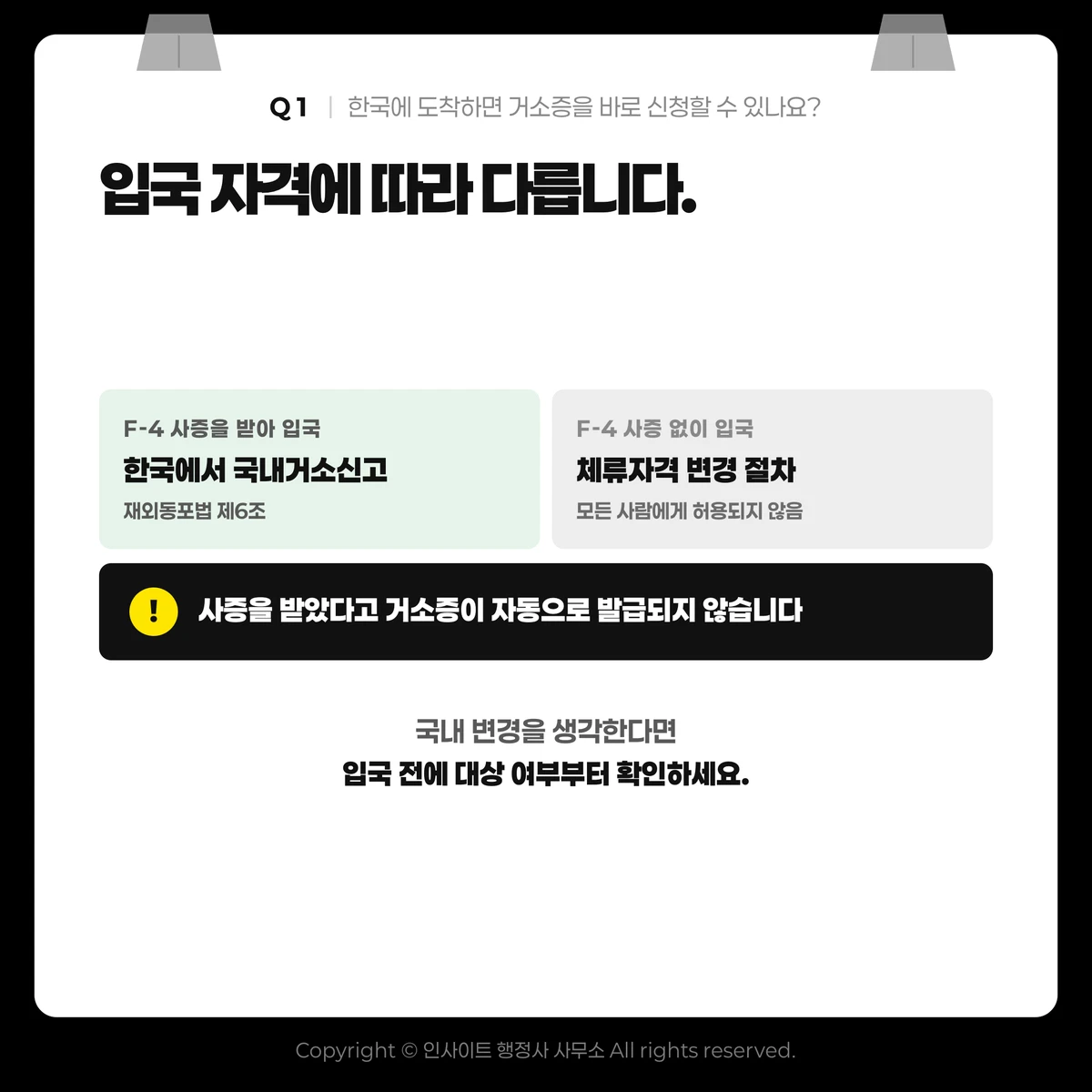
The procedures available to you in Korea depend on the status under which you enter.
If you entered with an F-4 visa issued by an overseas Korean mission, you will file a domestic residence report in Korea.
The domestic residence report is a procedure based on Article 6 of the Act on the Immigration and Legal Status of Overseas Koreans, and it is separate from the F-4 visa.
Receiving the visa does not mean a residence card is issued automatically.
If you enter without an F-4 visa and want to switch to F-4 in Korea, you must go through the change of status of stay procedure.
A change within Korea is not permitted for everyone, so you should first confirm whether you are eligible before entering.
If you are a U.S. citizen, read Changing to F-4 after visa-free entry first.
What to prepare for the residence report after entry is summarized in First F-4 domestic residence report.
What should I check first before entering Korea?
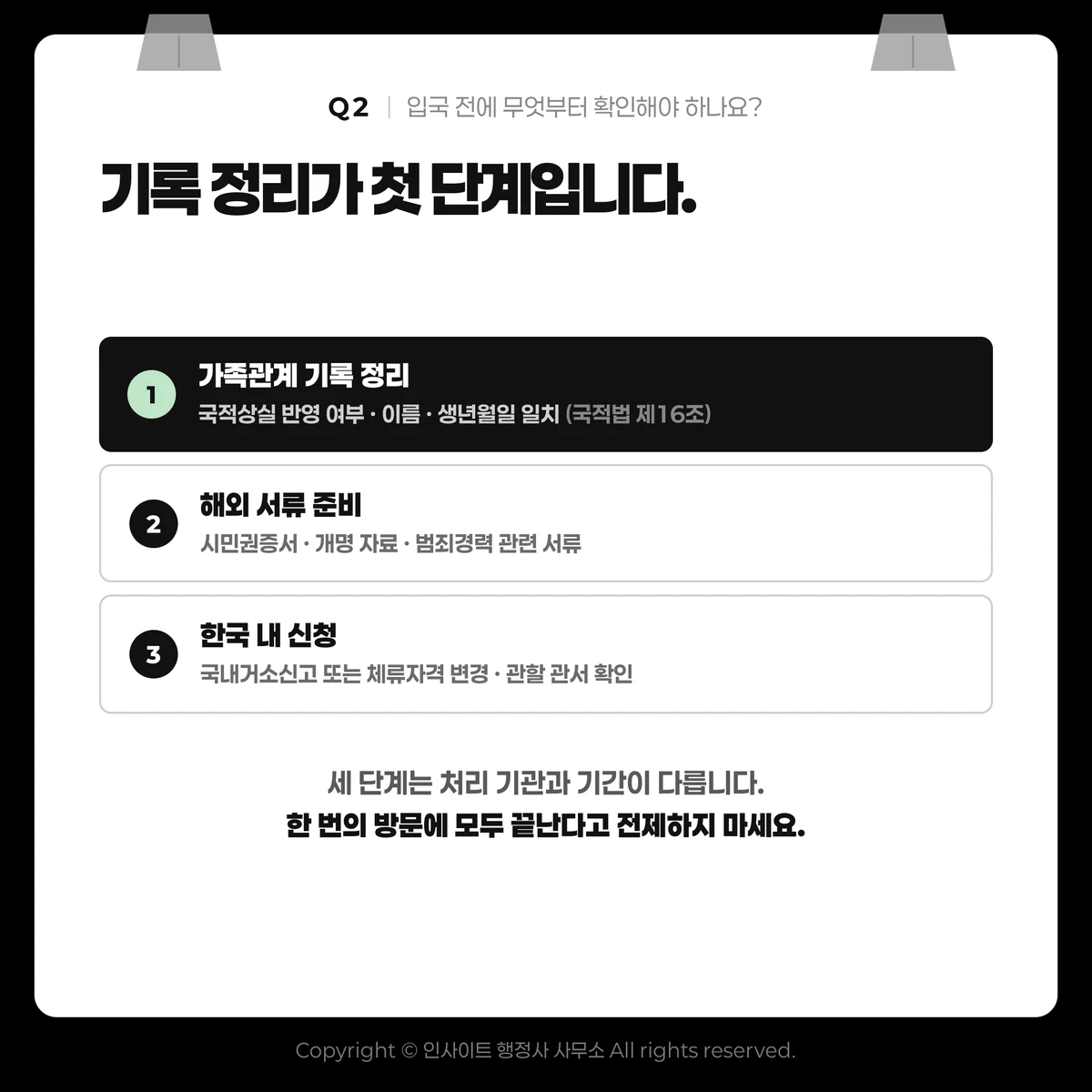
First, check whether the loss of nationality has been reflected in your Korean family relation records.
Article 16 of the Nationality Act requires a person who has lost Korean nationality to report the loss of nationality.
If the report has not been made, you may have to deal with this first after arriving in Korea.
Plan your pre-entry checks in the following order.
- Sorting out family relation records: whether the loss of nationality has been reflected, and whether the name and date of birth match between Korean records and foreign documents
- Preparing overseas documents: documents issued by foreign authorities, such as a certificate of citizenship, name change records, and criminal record documents
- Applying in Korea: domestic residence report or change of status of stay, and confirming the competent office
These three steps are handled by different authorities and take different amounts of time.
If one step is delayed, the next step is delayed as well, so it is safer not to assume that you can complete everything within a single visit.
How to prepare the loss of nationality report and the F-4 documents side by side is explained in How to prepare the loss of nationality report and F-4 together.
Why should overseas documents be completed before I leave for Korea?
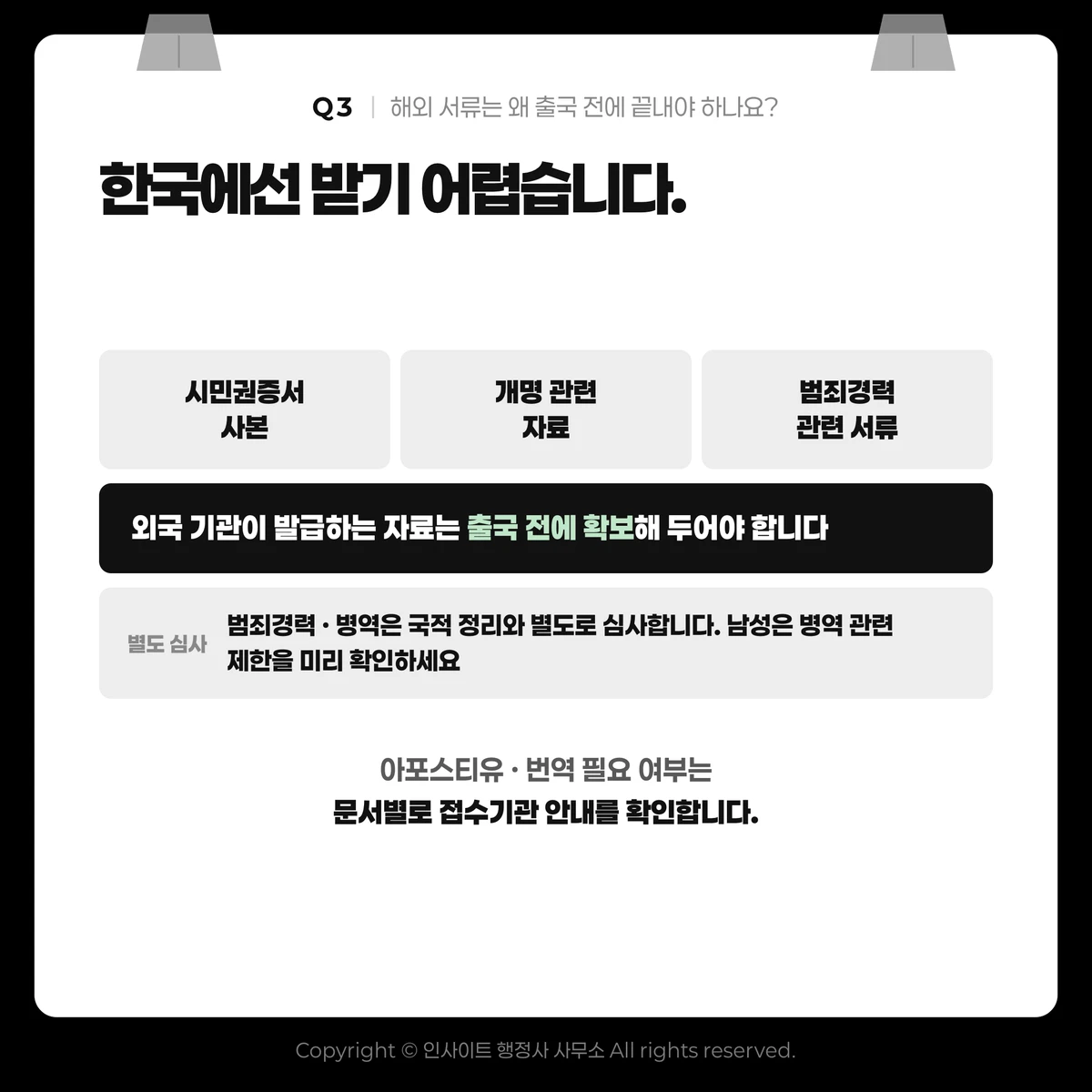
Because documents issued by foreign authorities are difficult to obtain after you arrive in Korea.
Documents issued abroad, such as a copy of your certificate of citizenship, name change records, and criminal record documents, should be secured before you depart.
Whether an apostille or translation is required should be checked document by document against the guidance of the receiving authority.
Criminal record and military service matters are reviewed separately from the nationality issue.
Male applicants should check in advance the military service-related restrictions that apply to them.
If you only find out after entering Korea that one of these applies to you, it will be difficult to respond within your stay.
Can I file the application and leave Korea first?
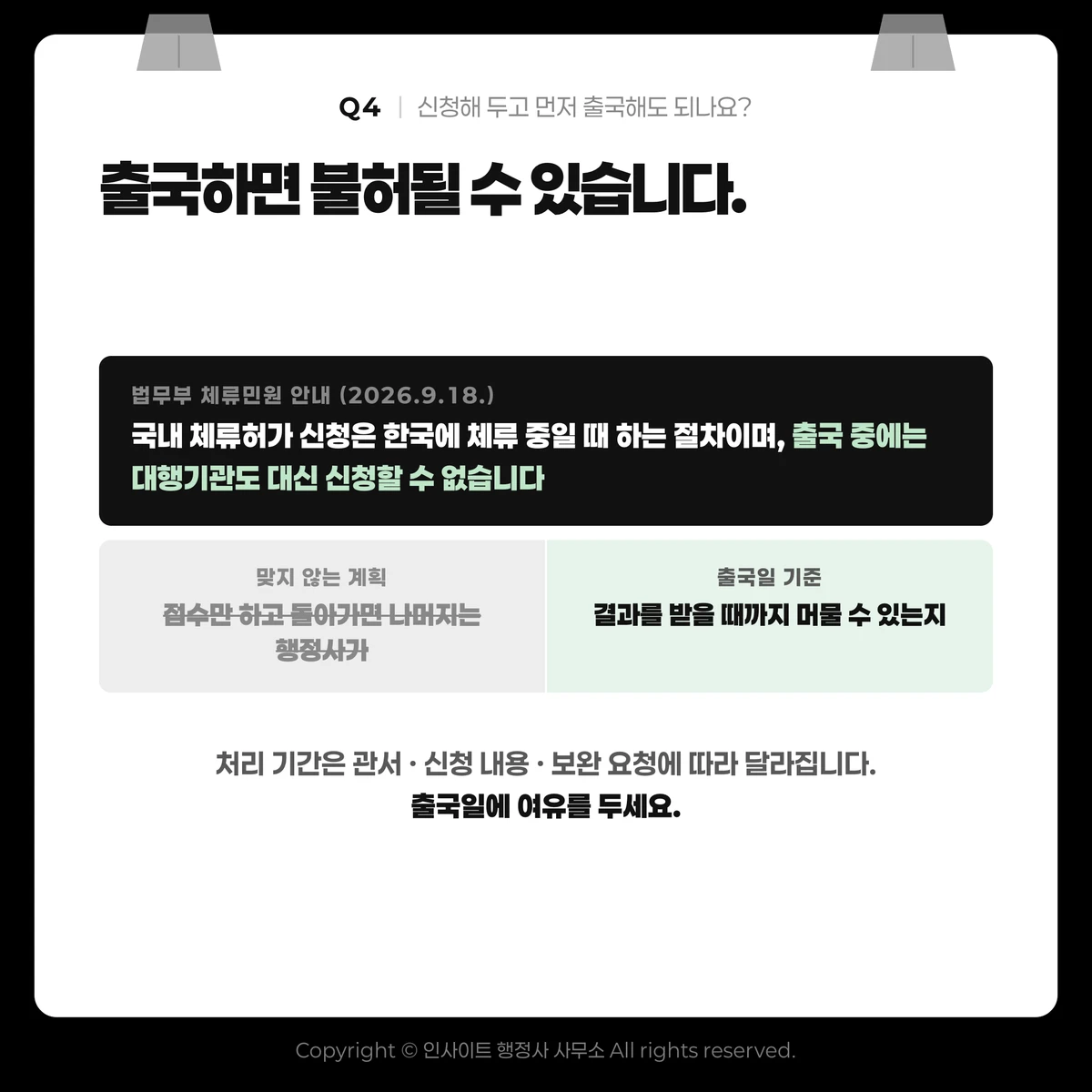
An application for domestic stay permission is a procedure filed while you are staying in Korea, and leaving the country after filing may result in denial.
The Ministry of Justice guidance on stay-related applications (Sept. 18, 2026) states that a foreign national seeking to apply for stay permission must be staying in Korea.
It also states that an immigration application agency cannot file on behalf of a foreign national who is outside Korea.
So the plan of “just submit the application and go home, and the administrative agent will handle the rest” does not work for domestic stay permission applications.
When setting your departure date, the standard should not be the filing date but whether you can remain in Korea until you receive the result.
Processing times vary by office, by what is being applied for, and by whether supplementary documents are requested, so it is advisable to leave margin in your departure date.
This principle is the same even if you engage an administrative agent office in Seoul.
If your stay in Korea will be short, you should compare before entry which route fits your schedule: obtaining a visa abroad first, or changing status within Korea.
If you would like help planning your trip
Please tell us your current nationality and country of residence, whether you have filed the loss of nationality report, your planned dates of entry into and departure from Korea, and the address where you will stay in Korea.
Insight Administrative Agent Office supports F-4 applications from Munjeong-dong, Songpa-gu, Seoul, and will guide you through a preparation sequence that fits your schedule by separating what to finish before entry from what to do in Korea.
If you have already booked your flights, we will explain what is possible within that schedule and what may be difficult.